
Design services for Minneapolis businesses
Design Agency Minneapolis
Strategy-led digital design built to attract qualified traffic, explain your value clearly, and turn more visits into leads and sales.
- Strategy led
- Search aware
- Responsive design


Design That Has a Job to Do
A design agency in Minneapolis should give your business more than a polished digital presence. The work must help the right people find you, understand what makes you different, and take the next step. That starts with clear positioning and a practical plan, followed by purposeful visual design, useful content, and careful development.
Website Design & SEO Solutions approaches each engagement as an experienced SEO service team in Minneapolis that connects design choices to search intent and business goals. Before concepts are presented, we work to understand your audience, competitors, sales process, and priorities. This keeps personal taste from becoming the only measure of quality. Decisions have reasons, and the finished work supports a defined customer journey.
Our office at 530 N 3rd St is in Minneapolis' North Loop, a district where converted industrial buildings sit alongside offices, shops, restaurants, and residential properties. That mix makes the local market highly visible and competitive. A professional firm may need to establish authority for a complex service, while a neighborhood business may depend more on location intent and quick mobile decisions. The design strategy should reflect that difference.
What Our Minneapolis Design Agency Can Deliver
Connected capabilities
Brand and Visual Direction
A practical visual system can include color, typography, imagery, iconography, and interface rules. Each element is selected to reinforce the company's position and remain consistent across common customer touchpoints.
UX and Interface Design
Sitemaps, user flows, wireframes, and high-fidelity mockups establish how information is organized and how people move toward an inquiry or purchase. Responsive behavior is planned for mobile, tablet, and desktop screens.
Content Structure
Headings, navigation labels, calls to action, service explanations, and proof points are arranged around the questions customers ask. Clear hierarchy helps readers scan quickly without losing the detail required for a considered decision.
Search-Aware Planning
Search intent, crawlable navigation, title structure, internal relationships, and indexation requirements are considered before development. This reduces the risk of treating organic visibility as an afterthought.
Development and Quality Review
Approved designs are translated into responsive components and tested across current browsers and common screen sizes. Reviews cover forms, navigation, content display, metadata, redirects, and basic accessibility.
Ongoing Improvement
Once real users arrive, analytics and search data can reveal unclear paths, weak content, or missed opportunities. Iterative changes are prioritized by evidence rather than a cycle of arbitrary redesigns.

Built Around Minneapolis Customers
Local context affects how people discover and judge a business. In Downtown Minneapolis, professional service firms often need concise explanations, credible proof, and a polished mobile experience for visitors moving between meetings. Northeast Minneapolis has a strong concentration of studios, galleries, breweries, and independent businesses, where distinctive visual identity can help a brand avoid blending into its category. Uptown businesses often compete for attention from nearby residents and people comparing options on mobile devices, so location information and direct action paths need to be easy to find.
The wider metro adds different search patterns. Edina businesses may market to established households and professional buyers who expect refined presentation and detailed service information. Bloomington companies can serve residents, corporate customers, and visitors connected to major destinations such as Minneapolis, Saint Paul International Airport and Mall of America. A sound design plan identifies which audiences matter instead of treating every metro search as interchangeable.
Minnesota's seasonal shifts also affect campaign timing, photography, promotional content, and demand in some industries. Planning reusable components makes those updates easier without changing the whole design. Location details should remain consistent as well, especially the business name, address, operating information, and other facts used by customers and search platforms.
How a Design Engagement Works
From discovery to refinement
A defined sequence connects business objectives, audience research, content, visual design, development, and evidence-based improvement.
Discovery and Scope
We define the business objective, target audience, required functions, content responsibilities, technical constraints, and approval process. The written scope identifies what will be delivered and which assumptions could affect timing.
Research and Architecture
Audience questions, competitor positioning, keyword intent, existing performance data, and content requirements inform the structure. A sitemap and user flows establish where information belongs before visual decisions take over.
Wireframes and Content
Wireframes establish hierarchy and conversion paths without relying on decorative detail. Content is drafted, edited, or mapped at this stage so the design accommodates real messages rather than placeholder copy.
Visual Design
The approved direction is applied to representative screen sizes and key templates. Typography, spacing, color, imagery, controls, and reusable components are documented to keep the experience consistent.
Build, Testing, and Launch
Development is followed by reviews for responsive behavior, forms, browser compatibility, accessibility basics, tracking, metadata, indexing controls, and redirects. Launch occurs after critical checks and stakeholder approval.
Measurement and Refinement
Post-launch data helps identify what people search for, where they enter, how they move through content, and where they stop. Future work can then focus on specific findings instead of broad visual changes.
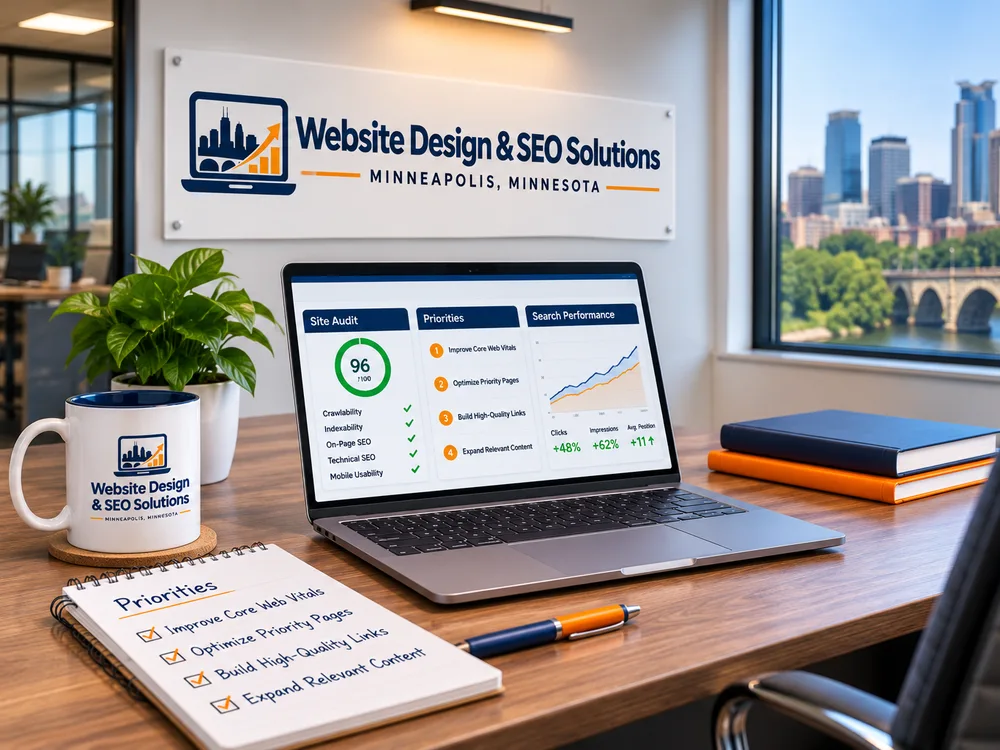
How to Compare Design Companies in Minneapolis
Start by asking how each agency connects design decisions to a business objective. A strong proposal should define deliverables, responsibilities, revision limits, milestones, technical requirements, and launch criteria. It should also say who owns the final design files, written content, code, domains, analytics accounts, and other assets. Ownership and access are easier to settle before work starts.
Review the thinking behind an agency's portfolio, not just its appearance. Ask what problem the work addressed, how content was organized, what constraints affected the result, and how success was measured. Attractive work in an unrelated market may be less useful than a well-reasoned project with similar customer behavior or sales complexity.
Technical questions matter too. Ask how the agency handles responsive design, semantic HTML, image compression, Core Web Vitals, keyboard navigation, color contrast, metadata, structured data, redirects, analytics, and content management. WCAG guidance is a common accessibility reference, while Google's Core Web Vitals include Largest Contentful Paint, Interaction to Next Paint, and Cumulative Layout Shift. These terms should connect to actual review practices rather than appear as proposal jargon.
Finally, clarify communication. You should know who leads the engagement, who performs the work, how feedback is consolidated, and what happens when scope changes. The best fit is an agency whose process matches your team's availability and decision-making style.
Performance Starts Before Development
Performance is shaped during strategy and design. Large media files, unnecessary scripts, poorly selected typefaces, complex animation, and weak content hierarchy can slow an experience before a developer writes the final code. Planning lightweight components and clear templates early gives the build a better foundation.
Search performance also depends on what the design makes possible. Important services need distinct, crawlable content. Navigation should reflect user needs rather than internal company terminology. Heading levels should follow a logical order, and key information should remain available as text instead of being trapped inside images. Canonical tags, XML sitemaps, robots directives, structured data, and redirect maps are technical tools, but none can compensate for content that does not answer the searcher's question.
Conversion planning is equally concrete. Each major screen should have a clear purpose, an appropriate next action, and enough evidence to support that action. For a professional service, that evidence might include process details, qualifications, case studies, or a precise explanation of fit. For a local business, operating area and contact options may carry more weight. Good design reduces friction without pressuring every visitor into the same path.
Accessibility belongs in the working process. Legible type, sufficient color contrast, visible focus states, descriptive labels, useful alternative text, and keyboard access improve usability for a broad range of people. These details should be checked in prototypes and tested again in the functioning build.
Bring your goals, current challenges, and required functions to the first conversation. We will help turn them into a practical scope with clear priorities.
Call for a free quoteQuestions About Hiring a Minneapolis Design Agency
Answers before you choose
How much does a design agency in Minneapolis cost?
Pricing depends on scope, content needs, technical complexity, and the depth of research required. A focused visual or interface engagement may cost several thousand dollars, while a custom multi-template project with strategy, content, integrations, development, and testing can reach tens of thousands of dollars or more. E-commerce, custom account functions, data migration, photography, and extensive stakeholder review increase the work. A reliable estimate requires a written brief and a discovery conversation.
How long does a typical design project take?
A focused project may take several weeks, while a larger custom engagement commonly requires several months. The schedule depends on the number of templates, content readiness, technical functions, review rounds, and how quickly decision-makers provide consolidated feedback. Minneapolis businesses planning around seasonal campaigns, events, or budget deadlines should establish a target launch date during discovery and leave time for testing.
Should we hire a local agency or a remote team?
A local agency is useful when in-person workshops, original Minneapolis photography, or direct knowledge of metro audiences will improve the work. Remote collaboration can also work well when roles, feedback, and approvals are clear. The better choice depends on process fit and relevant experience, not distance alone. Ask who will attend meetings, who will perform the work, and how decisions will be documented.
Can you redesign an existing digital presence without changing our brand?
Yes, a redesign can retain an established identity while improving structure, usability, responsiveness, content hierarchy, and technical quality. The first step is an audit of the current brand assets, templates, analytics, search visibility, integrations, and content. Existing URLs should be reviewed carefully because changing them without a redirect plan can disrupt customer access and organic search signals.
What should we prepare before contacting design companies in Minneapolis?
Prepare your primary business goal, target audiences, required functions, known technical constraints, desired launch window, and approximate investment range. Gather current brand files, analytics access, domain and hosting details, examples of content that must remain, and a list of stakeholders. If you serve distinct areas such as the North Loop, Northeast Minneapolis, Edina, or Bloomington, explain how customer needs differ by market.
Will search strategy be considered during design?
Search strategy should be incorporated before the structure and templates are approved. Useful inputs include keyword intent, current rankings, crawl data, analytics, content gaps, URL structure, internal relationships, metadata requirements, and redirect needs. Early coordination helps prevent a visually approved design from creating thin content, hidden information, or unnecessary URL changes.
Who owns the finished work after launch?
Ownership should be defined in the agreement before work begins. Confirm your rights to approved design files, custom code, written content, photography, fonts, stock media, domains, hosting, analytics, and third-party accounts. Some licensed assets remain subject to vendor terms. Your organization should also receive appropriate administrative access and a record of recurring services.
Build a Stronger Digital Presence
Tell us what your business needs to communicate, who it needs to reach, and what the finished work must accomplish. We will outline a clear path for strategy, design, production, and launch.