
Web development for Minneapolis businesses
Web Developers Minneapolis
Turn your business goals into a fast, accessible, responsive digital presence built for customers and search engines.
- Responsive layouts
- Accessible interactions
- Search-ready structure


Minneapolis Web Development Built Around Business Goals
The web developers Minneapolis businesses hire should understand more than code. A successful project starts with the people you need to reach, the actions they need to take, and the systems your team will use after launch. Website Design & SEO Solutions plans each build around those practical needs, with clear navigation, responsive layouts, accessible interactions, secure forms, and a content structure that search engines can interpret.
Our team works from 530 N 3rd St in Minneapolis, close to the North Loop business district. That location keeps us connected to a local mix of professional firms, hospitality businesses, retailers, service providers, and growing companies. A North Loop restaurant may depend on mobile reservations and location details, while a professional firm downtown may need detailed service content, lead qualification, and connections to customer management tools. Each build should reflect the way the business actually operates.
From the start, our team at an SEO service company Minneapolis businesses rely on handles planning, development, testing, and launch work with search visibility in mind. That means heading structure, crawlable navigation, metadata controls, redirects, image handling, and performance are considered during development rather than added as corrections after launch.
What Website Developers in Minneapolis Can Build
Development capabilities
Business Builds
Present services, locations, staff, case studies, and contact options through a clear information architecture. Content management tools let authorized staff update routine material without touching source code.
Ecommerce Development
Support product catalogs, payments, shipping rules, inventory workflows, customer accounts, and transactional messages. The technical plan should account for product volume and operational needs before a platform is selected.
Custom Features and Integrations
Connect forms, scheduling tools, customer relationship management systems, email platforms, analytics, and approved third-party services. Data mapping and error handling are defined before integration work begins.
Responsive Front-End Development
Build fluid layouts that adapt to phones, tablets, laptops, and larger displays. Touch targets, typography, menus, forms, and media are tested at practical viewport sizes.
Rebuilds and Migrations
Replace an outdated build or move content to a better-fit platform while preserving valuable URLs where practical. Redirect maps, content inventories, analytics checks, and launch backups reduce migration risk.
Ongoing Technical Work
Keep core software, extensions, integrations, backups, and security controls maintained after launch. Maintenance scope and response expectations should be documented rather than assumed.
Development Standards That Protect Performance
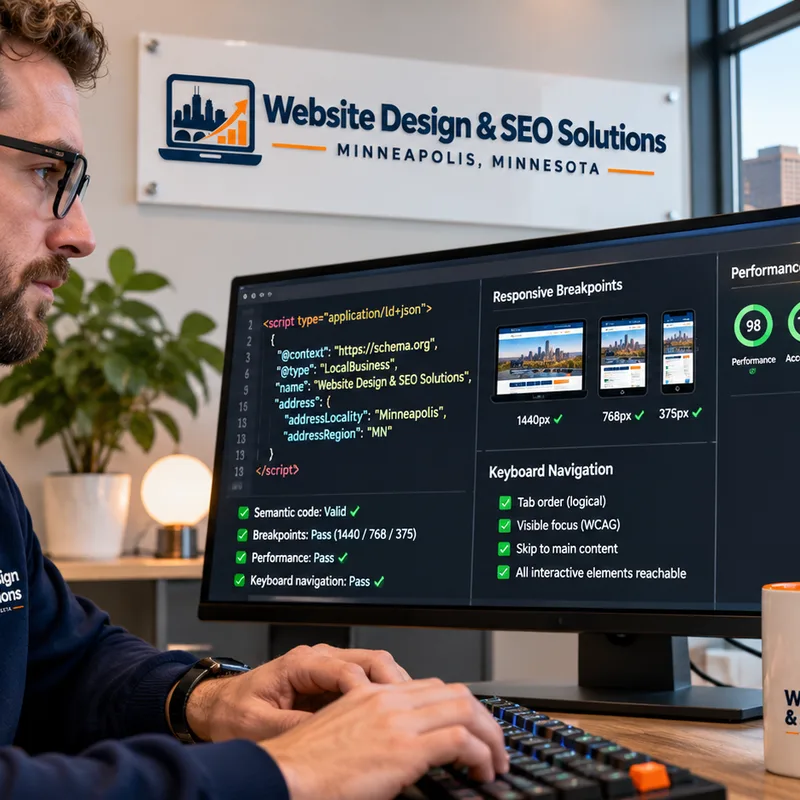
Good code supports speed, accessibility, maintenance, and search visibility at the same time. We favor semantic HTML, efficient CSS and JavaScript, properly sized images, dependable form validation, HTTPS, sensible caching, and clear component patterns. Where appropriate, we configure lazy loading and modern image formats. These choices help avoid common problems such as layout shifts, blocked interactions, oversized downloads, and templates that are difficult to update.
Core Web Vitals provide useful performance signals: Largest Contentful Paint concerns loading, Interaction to Next Paint concerns responsiveness, and Cumulative Layout Shift concerns visual stability. Those measurements are reviewed alongside real tasks such as opening a menu, completing a form, finding a location, or checking out on a phone. Automated scores are diagnostic tools, not substitutes for hands-on testing.
Accessibility is considered through keyboard operation, visible focus states, useful alternative text, labeled form controls, logical heading order, readable contrast, and error messages that identify what needs correction. WCAG provides the established framework for this work. Exact requirements depend on the organization and its legal obligations, so development scope should state the target level and testing method.
Our Minneapolis Website Development Process
From discovery to handoff
A defined sequence turns business requirements into an approved, tested build with clear responsibilities at every stage.
Discovery and Requirements
We identify business goals, audiences, required content, integrations, administrative roles, compliance concerns, and measures of success. Existing analytics and search data can reveal valuable content and technical problems.
Scope and Technical Plan
The project is translated into deliverables, responsibilities, milestones, platform requirements, and assumptions. A content inventory and URL plan clarify what will be retained, revised, combined, redirected, or removed.
Structure and Interface Planning
Sitemaps, user flows, wireframes, and interface concepts establish how people will move through the content. Mobile behavior is planned early because many customer journeys begin on a phone.
Development and Content Entry
Approved components are built, integrations are configured, and content is entered or migrated. Reusable templates keep presentation consistent while giving staff practical editing controls.
Quality Assurance
We test current browsers, common screen sizes, forms, keyboard access, links, tracking, metadata, redirects, and key integrations. Clients also review the work against the agreed scope before release.
Launch and Handoff
Deployment includes backups, domain and certificate checks, analytics verification, indexability review, and redirect testing. Training and documentation help the client team manage approved updates after launch.
Local Development for Different Minneapolis Audiences
Minneapolis website development has to account for distinct customer journeys within a compact market. Downtown professional firms often need clear expertise content, staff credentials, and lead routing. North Loop businesses may place more weight on mobile location details, reservations, product discovery, or event information. In Uptown, mobile visitors may be comparing nearby services quickly, so concise navigation and prominent operating details matter.
Northeast Minneapolis has studios, makers, neighborhood businesses, and creative organizations that may need image-led portfolios, event content, or ecommerce without sacrificing loading speed. Businesses serving communities across Minneapolis and Saint Paul often benefit from clear service-area information and location-specific contact routing. These are planning considerations, not reasons to duplicate thin content under a list of place names.
Minnesota's seasonal changes can affect customer behavior and campaign timing. Retail launches, event promotions, winter service demand, and summer construction schedules may create traffic spikes or time-sensitive updates. A practical content system lets staff publish notices and revise operating details without waiting for a developer to alter ordinary text.

How to Evaluate Website Developers Minneapolis Businesses Are Considering
Start with the proposed process, not a portfolio screenshot. Ask who owns discovery, design, development, content entry, testing, deployment, and post-launch maintenance. The written scope should define deliverables, revision limits, client responsibilities, exclusions, payment milestones, and what counts as completion.
Ask how the developer handles source code, administrative access, domain settings, analytics accounts, licenses, backups, and portability. Your organization should know which assets it will own, which tools require recurring fees, and how access is transferred. If the project replaces an existing build, request a content inventory and URL redirect plan. Launching without redirects can break useful inbound paths and waste established search equity.
Technical claims should be specific. A capable team can explain its approach to responsive behavior, browser testing, accessibility, security updates, structured data where relevant, performance, and form privacy. It should also describe what happens when a third-party integration fails. Clear answers make proposals easier to compare and expose assumptions before they become change requests.
What a Clear Development Proposal Should Cover
Proposal essentials
Defined Deliverables
The proposal should identify templates, functional requirements, content responsibilities, integrations, testing, training, and launch tasks in plain language.
Platform Rationale
The recommended content management system or framework should fit editing needs, functionality, budget, maintenance capacity, and expected growth.
Ownership and Access
Domain control, hosting access, source files, content, analytics, account credentials, and licensed assets should have clearly stated ownership and handoff terms.
Change Control
A written process should explain how new requests affect price and timing. That protects both parties when requirements change during the work.
Launch Criteria
Acceptance should depend on agreed functionality and testing, including forms, redirects, analytics, indexability, responsive behavior, and supported browsers.
Post-Launch Terms
Maintenance, hosting, backups, software updates, support availability, and recurring costs should be separated from the initial build when they are separate services.
Bring your goals, current technical concerns, and required integrations to the first conversation. We will help turn them into a practical scope with clear responsibilities and a defined route to launch.
Call for a free quoteQuestions About Web Development in Minneapolis, MN
Answers before you choose
How much does Minneapolis web development cost?
Pricing depends on scope, content volume, custom functionality, integrations, and who is responsible for content and visual assets. A focused business build using established components generally costs less than ecommerce or a custom application with user accounts and complex data flows. Hosting, paid software licenses, maintenance, content production, and migration may be separate costs. A written discovery process is the reliable way to establish a budget because two projects with the same number of templates can require very different development effort.
How long does Minneapolis website development take?
A defined business project commonly takes several weeks to a few months, while complex ecommerce, migration, or custom application work can take longer. Timing depends on approvals, content readiness, integrations, revision cycles, and stakeholder availability. Minneapolis organizations planning around an event, campaign, or seasonal sales period should set the launch target early and leave time for testing. A phased release may be appropriate when the full scope cannot be completed safely by a fixed date.
Can you rebuild an existing business presence without losing search visibility?
A rebuild can preserve valuable search signals when URLs, content, metadata, internal navigation, and redirects are planned before launch. The process should include a crawl or URL inventory, a map of old addresses to their best new destinations, preservation of useful content, and post-launch checks in analytics and Google Search Console. Rankings cannot be guaranteed, and major changes may cause fluctuation. Careful migration work reduces avoidable losses caused by missing content, broken paths, or accidental indexing blocks.
Which platform should website developers in Minneapolis recommend?
The right platform is the one that fits the required functions, editing workflow, maintenance capacity, security needs, and budget. WordPress can suit many content-driven business projects, while established commerce platforms may be better for stores that need dependable catalog and payment tools. A custom framework may be justified for specialized workflows or application behavior. The recommendation should follow documented requirements rather than a developer's preference for one tool.
Will the finished work be usable on mobile devices?
Responsive behavior should be part of the core build and tested on practical phone, tablet, and desktop viewport sizes. Testing covers navigation, forms, tap targets, text readability, media, tables, and important customer tasks. This matters for Minneapolis businesses whose customers may be looking up directions, booking services, or comparing options while away from a desk. Mobile quality also depends on performance, so image weight and script behavior need attention.
Who supplies the content and images?
Content responsibility should be assigned in the proposal before production begins. The client may provide final copy and approved photography, or content work may be added to the scope. Developers still need content early enough to build accurate templates and test long headings, tables, images, and calls to action. Licensed stock media should have documented usage rights, and staff or customer images require appropriate permission.
Do you provide support after launch?
Post-launch support can be defined around maintenance, backups, software updates, monitoring, technical fixes, and planned enhancements. The agreement should state what is included, how requests are prioritized, and whether hosting or third-party license fees are separate. Staff training may cover routine content changes, but platform updates and integration failures often require technical work. Clear support terms are especially useful for organizations that do not have an internal development team.
Can development connect with our scheduling, CRM, or payment tools?
Many established tools can be connected through supported extensions or application programming interfaces, subject to the vendor's capabilities and access rules. Discovery should confirm required data fields, direction of transfer, authentication, error handling, privacy needs, and recurring vendor charges. Before committing to custom integration work, we verify the available documentation and whether the third-party provider offers a supported method. That avoids building a workflow around access the vendor does not permit.
Plan Your Minneapolis Web Development Project
Tell us what the finished build needs to accomplish, who will manage it, and which systems it must connect with. We will discuss the requirements and outline a practical next step.