
WordPress design for Minneapolis businesses
WordPress Design in Minneapolis
Get a fast, polished business presence shaped around your brand, customers, content, and long-term goals.
- Responsive layouts
- Practical editing
- Performance planning

A Business-Focused WordPress Design
Effective WordPress design Minneapolis businesses can rely on starts with a clear purpose. The design should help visitors understand what you do, find the right information, and take the next step without friction. It also needs to be easy for your team to manage after launch.
Website Design & SEO Solutions plans each project around your audience, services, content, and brand rather than forcing the work into a generic theme. Our SEO service specialists across Minneapolis, MN consider search structure while organizing navigation, headings, service content, and calls to action. That foundation supports discoverability without sacrificing clarity or visual quality.
Our office at 530 N 3rd St is near the North Loop, a district where professional services, restaurants, retailers, and growing companies compete for attention online. That mix reinforces a practical design principle: visitors should immediately know whose business they have reached, what it offers, and how to act.
What Your WordPress Project Can Include
Connected capabilities
Custom Visual Direction
Typography, color, spacing, imagery, and interface components are selected to fit your established brand or a clearly defined new direction. The result feels specific to your business rather than assembled from unrelated template parts.
Responsive Layouts
Every key layout is planned for phones, tablets, laptops, and larger screens. Navigation, forms, buttons, images, and content remain usable at each breakpoint, especially when customers browse while traveling around the Twin Cities.
Clear Content Architecture
Navigation and content hierarchy are organized around customer intent. Descriptive headings, focused service content, logical URLs, and useful internal connections help people and search engines understand the material.
Practical WordPress Editing
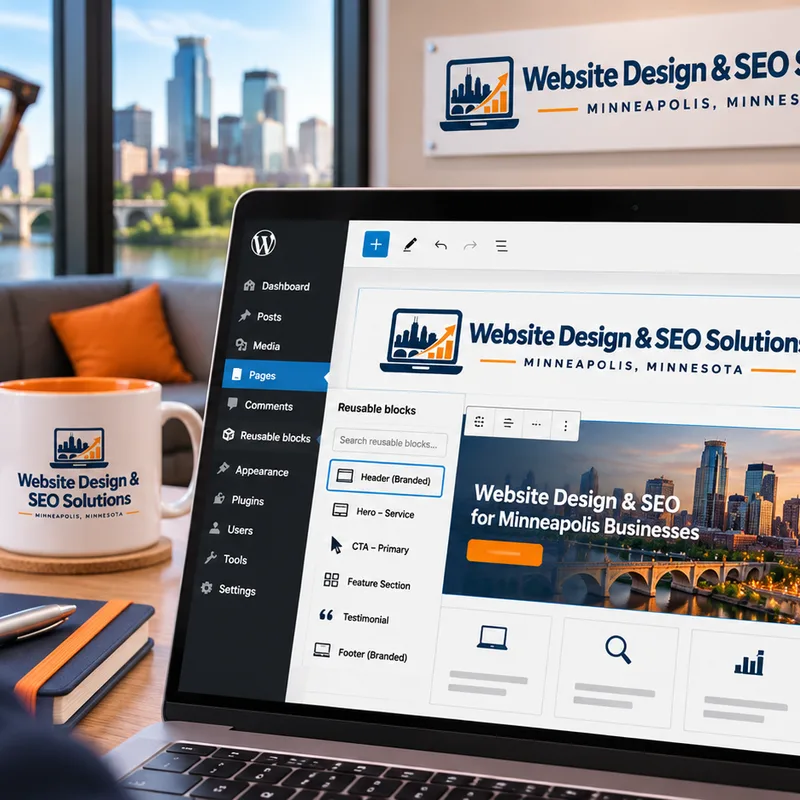
Reusable blocks and sensible editor controls let your team update ordinary content without rebuilding layouts. Permissions and editing options can be limited so routine changes do not damage the design.
Performance Planning
Image compression, modern file formats, restrained plugin use, caching, clean templates, and dependable hosting all affect load time. Performance is considered during design rather than treated as a final repair.
Accessible Interaction
Readable contrast, keyboard-friendly controls, meaningful labels, visible focus states, and structured headings make the experience easier to use. Accessibility is addressed throughout planning, design, and review.
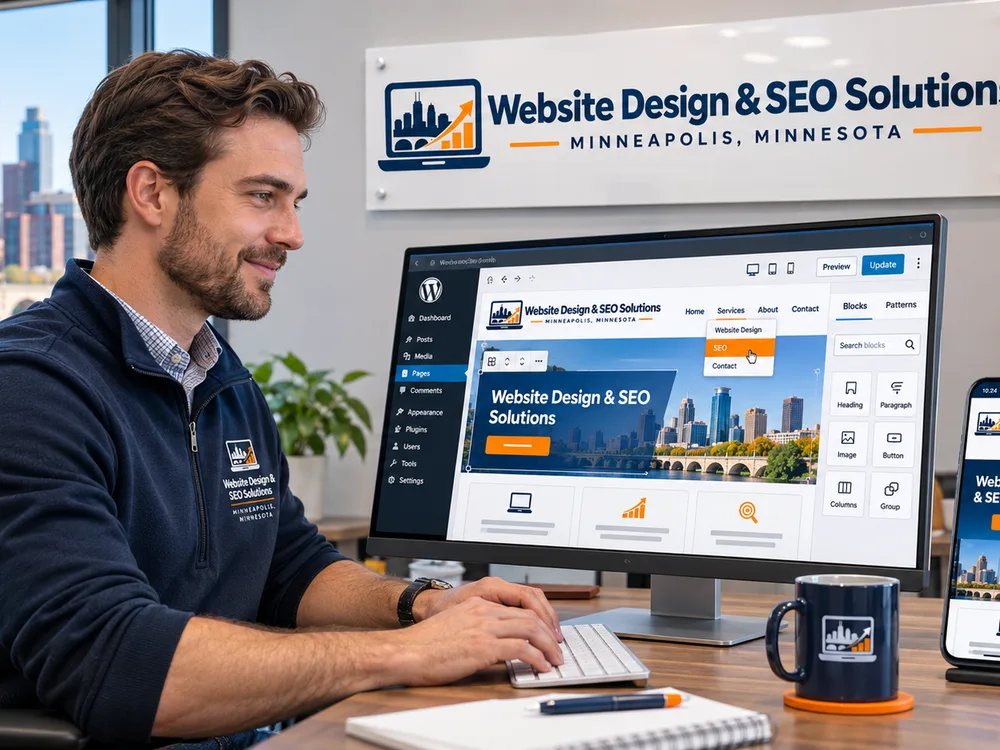
WordPress Design Minneapolis Companies Can Use and Maintain
A polished design has to work after launch. We build around the WordPress block editor and choose reusable patterns that match the way your team publishes. A staff member might need to change a biography, add a project, revise a service description, or publish an article without involving a developer every time.
That flexibility requires boundaries. Global styles keep fonts and colors consistent. Reusable components keep calls to action, cards, and content rows aligned. Role-based permissions can give editors the access they need while reserving system settings for administrators.
Minneapolis businesses also operate across very different customer settings. North Loop companies may need concise mobile information for visitors comparing options near offices and entertainment venues. Neighborhood businesses in Uptown may depend on location details and service-area clarity. Organizations near the University of Minnesota may serve students, staff, researchers, or institutional buyers with distinct information needs. The content structure should reflect the actual audience instead of inserting place names as decoration.
Our WordPress Design Process
From discovery to ongoing care
A defined sequence connects business goals, content structure, visual design, development, testing, and practical handoff.
Discovery and Scope
We discuss your goals, customers, current content, required functions, brand materials, and launch priorities. The resulting scope identifies deliverables, responsibilities, assumptions, and approval points before design work begins.
Content and Structure
We map primary navigation, core content, user paths, and calls to action. Existing material is reviewed for gaps and duplication. This step prevents visual decisions from hiding weak organization.
Wireframes and Visual Design
Wireframes establish hierarchy and layout without decorative distraction. Approved concepts then receive typography, colors, imagery, responsive behavior, and interface details that fit your brand.
WordPress Development
The approved design is built with reusable components and appropriate editor controls. Forms, integrations, menus, templates, metadata, redirects, and technical settings are configured according to the agreed scope.
Testing and Launch
We review representative phones and computers, major browsers, forms, keyboard navigation, content, and redirects. Launch follows approval, with backups and final checks completed before the new build becomes public.
Training and Ongoing Care
Your team receives guidance for the editing tasks included in the project. Updates, backups, security monitoring, performance checks, and future improvements can be planned according to your internal capacity.
Built for Search, Speed, and Real Customers
Search-friendly WordPress design begins with structure. Each important topic needs a clear purpose, descriptive title, logical heading order, useful copy, and a URL that makes sense. Search visibility also depends on factors beyond visual design, including content quality, business information, competition, authority, and ongoing technical maintenance. Ethical planning cannot promise a specific ranking.
Performance decisions are more concrete. Large uncompressed images, unnecessary scripts, excessive font files, and overlapping plugins add weight. We favor properly sized images, WebP or AVIF where appropriate, caching, limited third-party code, and templates that avoid needless complexity. Core Web Vitals provide useful measures of loading performance, responsiveness, and visual stability, but they are part of a broader user experience.
Local intent deserves careful treatment too. A business serving Northeast Minneapolis may need service-area and appointment information to appear early for mobile visitors. A professional firm in Downtown Minneapolis may need credentials, industries served, and contact paths to be more prominent. These are content and usability choices, not excuses to repeat the city name unnaturally.
How Much Does WordPress Design Cost in Minneapolis?
Project investment
Custom WordPress design in Minneapolis typically ranges from $4,000 to $15,000 for a small or midsize business project. A focused brochure build may fall near the lower end, while extensive custom templates, integrations, ecommerce, membership functions, or substantial content work can raise the price beyond that range.
Final cost depends on content volume, custom design depth, copy needs, data migration, accessibility requirements, integrations, and review rounds. Hosting, premium software, maintenance, and photography may be separate expenses. Your exact price is confirmed after a consultation defines the scope, responsibilities, and launch requirements.
A Better Foundation Than a Generic Theme
An off-the-shelf theme can suit a limited budget when its structure closely matches the project and customization needs are modest. Problems arise when a team tries to force a mismatched theme to support unusual content, integrations, or brand rules. Extra plugins and overrides can make editing harder and increase maintenance work.
Custom design provides greater control over hierarchy, components, responsive behavior, and editorial workflows. That does not mean every element must be invented. WordPress already offers mature publishing tools, and trusted plugins can handle suitable functions. The goal is to choose the simplest dependable approach for each requirement.
Ownership and administration should also be clear. Your organization should understand its hosting arrangement, domain access, administrator accounts, software licenses, backup process, and maintenance responsibilities. Those operational details matter as much as the visual files when the project changes hands later.
Bring your goals, current content, required functions, and preferred launch timing to the initial conversation. We will identify the right scope and explain the work involved before the project begins.
Call for a free quoteQuestions About WordPress Design in Minneapolis
Answers before you choose
How long does a custom WordPress project take?
A typical small or midsize business project often takes 8 to 16 weeks after scope approval, although complexity and feedback timing can change the schedule. Content readiness, integrations, migration needs, and the number of decision-makers are common variables. Minneapolis organizations with seasonal campaigns or fixed event dates should raise those deadlines during discovery so planning can work backward from a realistic launch window.
Can you redesign my existing WordPress presence without losing content?
Yes, existing WordPress content can often be migrated or reorganized during a redesign. We first audit templates, posts, media, plugins, forms, URLs, and analytics to identify what should remain, change, or be retired. Redirect planning is especially important when established Minneapolis service URLs receive search traffic or customer referrals.
Will my team be able to make updates after launch?
Yes, the editing experience can be configured around the updates your team actually performs. Reusable blocks, global styles, and role-based permissions make common changes more controlled. Training can cover publishing, image preparation, form entries, and other agreed tasks, while technical settings remain restricted to appropriate administrators.
Can a new WordPress design guarantee better Google rankings?
No, a WordPress redesign cannot guarantee rankings or traffic. It can improve technical structure, mobile usability, crawlability, internal organization, metadata, and content presentation. Results also depend on competition, relevance, authority, reviews, business information, and continued content work in the Minneapolis market.
Do I need custom design, or would a prebuilt theme be enough?
A prebuilt theme may be enough when your content is simple, your brand requirements are flexible, and the theme already supports the needed layouts. Custom design is more suitable when your organization needs distinct components, specialized integrations, strict brand control, or a tailored editing workflow. Discovery should compare those requirements before either route is recommended.
What should I prepare before requesting a WordPress quote?
Prepare your business goals, target audiences, required functions, current domain and hosting details, brand assets, approximate content volume, and desired timing. Examples of designs you like can clarify preferences, but the reasoning matters more than imitation. If several Minneapolis departments or partners must approve the work, identify those decision-makers and review stages early.
Ready to Plan Your WordPress Project?
Tell us what your business needs to communicate, what customers should be able to do, and what is not working now. We will help define a practical scope, timeline, and budget for the project.