
Online marketing for Minneapolis businesses
Online Marketing Minneapolis
Turn search demand into qualified inquiries with a coordinated strategy built around clear positioning, useful content, local visibility, and measurable conversion paths.
- Search visibility
- Local discovery
- Qualified inquiries


A Practical Strategy for Reaching Minneapolis Customers
Effective online marketing in Minneapolis starts with a simple question: who needs to find your business, and what evidence will help that person take the next step? The answer shapes search targeting, content, local listings, conversion paths, and campaign priorities.
Website Design & SEO Solutions approaches the work as a SEO service company in Minneapolis, MN focused on aligning your message with real customer searches and business goals. We review how people discover the business, which searches show buying intent, what competitors communicate, and where prospective customers lose confidence. That analysis becomes a prioritized plan rather than a disconnected list of marketing tasks.
Local context affects the plan. North Loop has dense commercial activity and a mix of offices, retail, hospitality, and residential buildings, so proximity and mobile discovery may matter for businesses serving customers nearby. Downtown Minneapolis can involve commuters, event traffic, and professional buyers who compare options quickly. Northeast Minneapolis includes commercial corridors, studios, restaurants, and established residential areas, which can create several distinct audiences within a compact area. Businesses serving Uptown often need to account for neighborhood-level searches and mobile users looking for nearby choices. Regional providers may also need dedicated coverage for customers in St. Paul and the surrounding suburbs instead of treating the Twin Cities as one interchangeable market.
What Online Marketing in Minneapolis Should Cover
Connected capabilities
Search Visibility
Keyword research separates broad research queries from searches that signal a customer is ready to compare providers. Technical review, content planning, internal organization, title tags, and helpful service information support organic visibility.
Local Discovery
A complete Google Business Profile, consistent business details, relevant categories, service information, photos, and a responsible review process help customers evaluate a nearby company. Local work should also make the service area clear without producing thin, repetitive location copy.
Conversion Planning
Traffic has limited value when visitors cannot understand the offer or find a sensible next step. Strong conversion paths use clear calls to action, useful proof, focused forms, readable mobile layouts, and tracking that records meaningful inquiries.
Content Strategy
Content should answer questions that arise before a purchase, including scope, process, timing, suitability, and cost factors. Each piece needs a defined search intent and a clear relationship to the services the business actually provides.
Reputation and Trust
Accurate claims, current information, customer feedback, credentials when applicable, and consistent branding reduce uncertainty. Trust signals should support the decision instead of crowding the message.
Measurement and Improvement
Analytics should distinguish valuable actions from superficial activity. Form submissions, qualified calls, booked consultations, and other business-specific outcomes provide better direction than traffic totals alone.
Local Search Requires More Than Adding a City Name
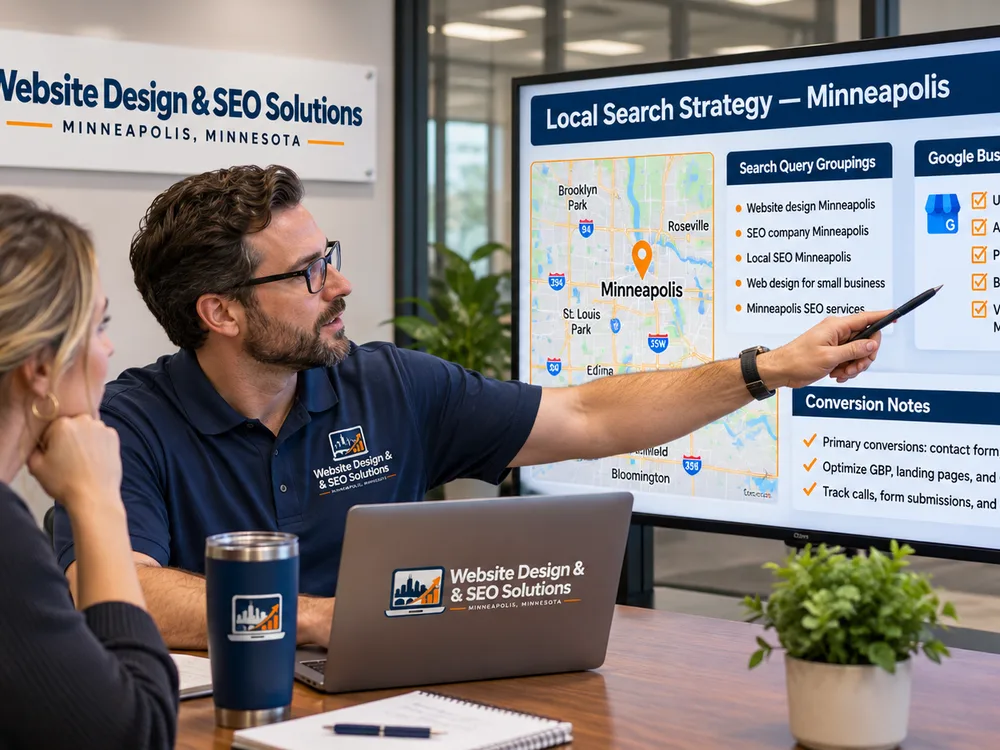
Minneapolis businesses compete across neighborhood, city, and regional search results. The correct geographic scope depends on how customers buy. A walk-in business may focus tightly on nearby discovery, while a professional firm may draw prospects across Minneapolis, St. Paul, and suburban communities.
Google Business Profile supports visibility in local results, but relevance, distance, and prominence all affect what users see. A business cannot control a searcher's distance. It can improve the accuracy and usefulness of its profile, maintain consistent contact information, choose truthful categories, publish clear service details, and earn genuine reviews without incentives or fabricated feedback.
Location content also needs substance. A useful local resource connects a service to customer needs in that market. It should not swap place names into otherwise identical text. Search engines and prospective customers both benefit when information reflects actual service coverage, decision factors, and buying intent.
Minneapolis seasonality can change demand and campaign timing. Winter conditions may increase reliance on online research, remote consultations, and mobile contact, while warmer months can alter demand for appointment-based, retail, property, and event-related businesses. Campaign budgets and publishing schedules should follow the company's own lead history rather than assumptions about the entire market.
How an Online Marketing Plan Takes Shape
From baseline to refinement
A defined process connects market priorities, search intent, implementation, qualified lead measurement, and ongoing decisions.
Clarify the Market and Goal
We identify priority services, customer types, service areas, sales capacity, and the actions that count as qualified leads. This keeps the strategy tied to revenue opportunities the business can support.
Establish a Measurable Baseline
The review covers search visibility, content quality, technical barriers, local listings, mobile usability, conversion paths, and available analytics. Existing strengths are preserved while gaps are ranked by likely business impact.
Build the Search and Content Plan
Search terms are grouped by intent, topic, and geography. Each important query group receives a suitable destination, avoiding several pieces of content that compete for the same search.
Implement Priority Work
Work may include technical corrections, content improvements, local profile updates, conversion changes, tracking configuration, or campaign setup. The order depends on dependencies and the fastest credible route to useful data.
Review Leads and Refine
Reporting connects visibility and engagement to qualified actions. Search queries, landing performance, form quality, call outcomes, and sales feedback guide the next round of changes.
Search Engine Optimization, Paid Media, and Content Have Different Jobs
Organic search builds visibility around topics and queries that matter over time. Paid search can place an offer in front of people actively searching now, but targeting, bids, landing relevance, and conversion tracking determine whether that spend produces useful inquiries. Content supports both channels by answering the questions prospects ask before choosing a provider.
These methods should share a message and measurement plan without being treated as interchangeable. Paid campaigns can reveal which queries and offers attract serious prospects. Organic search can build durable coverage around valuable subjects. Email and remarketing may help businesses with longer buying cycles stay visible after an initial visit, provided consent and platform rules are respected.
Technical fundamentals still matter. Search engines need to crawl and understand the content. Visitors need fast, stable, mobile-friendly experiences. Important checks include indexability, canonical tags, redirects, XML sitemaps, structured data where appropriate, Core Web Vitals, and accurate event tracking. Technical work should support useful content and a clear customer journey rather than become an end in itself.

What Useful Reporting Looks Like
A marketing report should answer what changed, why it matters, and what happens next. Rankings can provide diagnostic information, but they do not show whether inquiries are qualified. The stronger view combines search visibility with conversions and sales feedback.
For local campaigns, reporting may include Google Business Profile interactions, organic landing performance, geographic patterns, form completions, and tracked calls. Paid campaigns add search terms, cost per qualified action, impression share, and landing conversion data. Tracking needs documented definitions so routine events are not mistaken for leads.
Attribution also has limits. A customer may discover a company through local search, return through a branded query, and make contact after reading reviews. No single channel report captures every influence perfectly. Good analysis acknowledges those limits, looks for consistent patterns, and avoids claiming certainty the data cannot support.
Get a focused marketing plan that identifies the strongest opportunities, the work required, and the measurements that will guide future decisions.
Call for a free quoteQuestions About Online Marketing in Minneapolis
Answers before you choose
How much does online marketing in Minneapolis cost?
Monthly costs depend on channel mix, competition, geographic reach, content needs, and how much implementation is included. A local campaign focused on organic search and Google Business Profile work has a different scope than a Twin Cities campaign combining SEO, paid search, content production, and conversion tracking. A consultation should define priorities, deliverables, reporting, and any advertising spend before pricing is confirmed.
How long does SEO take to produce meaningful results?
SEO usually requires several months to show a clear trend, while timing varies with the starting condition, competition, and scope of work. Technical corrections may be processed sooner, but competitive Minneapolis search terms often require sustained content, authority, local relevance, and conversion improvements. Reporting should track early indicators without presenting rankings or traffic as guaranteed business results.
Should a Minneapolis business invest in local SEO or paid search first?
The right starting point depends on urgency, budget, search demand, and the strength of existing assets. Paid search can test offers and capture immediate demand, while local SEO builds organic and map visibility over time. Businesses with an incomplete Google Business Profile or weak conversion tracking may need those foundations corrected before either channel receives substantial investment.
Can one campaign target Minneapolis, St. Paul, and the suburbs?
One coordinated campaign can cover the Twin Cities region, but the targeting and content should reflect real service coverage and customer intent. A company serving the full metro may need regional themes and selective city-specific content. A neighborhood business generally benefits from tighter geographic targeting because users often prefer a nearby option.
What access is needed to begin?
Access commonly includes Google Business Profile, Google Analytics, Google Search Console, advertising accounts, domain or content management tools, and existing reporting. Ownership should remain with the business whenever possible. Permissions can be limited by role, and account access should be documented before implementation begins.
How will I know whether the marketing is attracting qualified leads?
Qualified lead measurement requires agreed definitions and tracking tied to meaningful actions. Form fields, call outcomes, booked appointments, customer relationship management data, and sales feedback can separate serious prospects from spam or poor-fit inquiries. Minneapolis location data may also show whether contacts come from the intended service area.
Do you guarantee first-place Google rankings?
No credible provider can guarantee a particular organic ranking because search results vary by query, location, device, competition, and algorithm changes. A responsible plan controls what can be improved: technical quality, relevance, local accuracy, content usefulness, conversion paths, and measurement. Expectations should be based on documented work and observed trends rather than a promised position.
Build a Clearer Path From Search to Inquiry
Share your goals, priority services, and current marketing concerns. Website Design & SEO Solutions will help define a practical scope for reaching qualified customers in Minneapolis and measuring what follows.